Showing posts with label evergreens. Show all posts

October 12, 2012

Triangles, Circles and Squares - oh my!


Math was never my strongpoint. In fact, my attempts to understand math in school were dismal failures.
Art, on the other hand, was my favourite class! When I started gardening, I realized that I liked to compose "pictures" using plant shapes and colours. Had someone pointed out to me that math was involved there too, I would have denied it, but it's true.
The most successful landscape design is based upon proportionately combining mathematical shapes - triangles, rectangles, squares and circles.
While on vacation this summer, I couldn't help but notice the evergreen placement beside the greenhouse of a friend's property that we visited.


Across the front area they have an upward curving mugho pine, then a low-growing golden juniper and then a lighter coloured shrub.
Across the back there is a large triangular spruce and a smaller triangular one.


Once you start looking for geometric shapes, it's easy to identify them and see how they fit together in a well balanced way.


This probably just "happened" (because the building was constructed long after the garden was planted) but the 2 triangles in the garden are echoed by the triangular roof of our friend's cottage.

Many formal gardens are designed using geometric shapes.


The allee of trees are like lollipops. Their rounded tops echo the curves in the castle windows. This is Rundale Palace in Latvia.


Arched half circles add a soft elegance to the garden area.


Look at the shapes here - so easy to spot when you really look.

It's also fun to look at scenic spots and realize that Mother Nature has an innate sense of design and proportion.
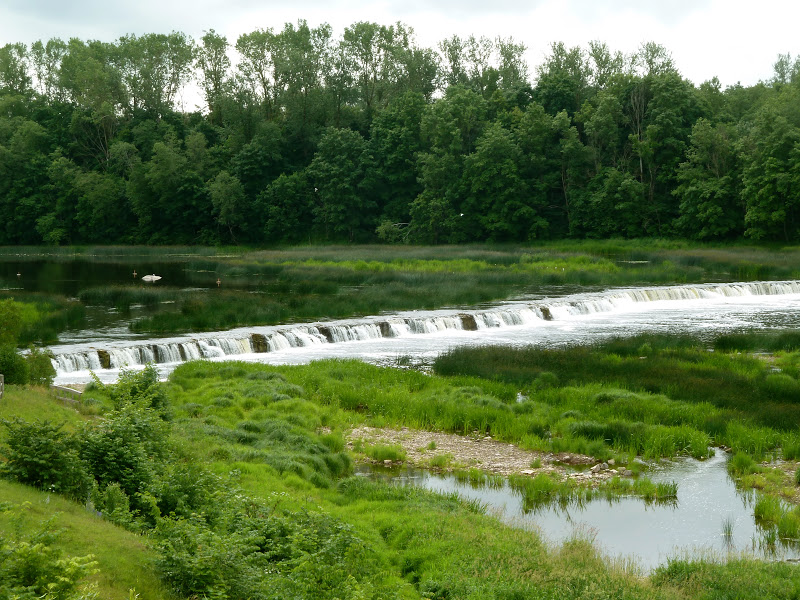

This is Ventas Rumba (the Venta river waterfalls) in Latvia - hardly Niagara, but it is famous in that it's the widest waterfalls in Europe.

Take a look at your own garden and see if adding a circular shrub or triangular evergreen would not add accent to your perennial border.


July 31, 2012

Combining Plant Textures in the Garden


When people think of designing their garden, they usually think of size and colour first: how big is the plant going to become? What colour will it be in summer? in autumn?
Then they attempt to place the different plants into beds using the design concepts of proportion, order and repetition.
It's easy to forget about or ignore texture but this element is also very important.

Texture refers to the surface quality of a plant. Plant textures range from fine to medium to coarse. Most plants have a medium texture so it's a great idea to combine medium with fine and coarse. This adds interest as well as achieves an atmosphere of calm relaxation or of drama.


Feather Reed grass 'Karl Foerster" has 2 types of texture: the sharp, vertical stalk and the fluffy soft plumes.


An article from Landscape Ontario http://landscapeontario.com/ says that "…the easiest way to assess the amount of contrast in the texture of the garden is to imagine a black and white photo of the area. The removal of colour helps to focus attention on the size and shape of the foliage and woody components beyond the appeal of their overall form and colour."

I tried this and it works!! Compare above and below. Look how the sharp needles of the mugo pine contrast with the thick, rounded leaves of the Sedum and the long, thin foliage of the Miscanthus grass and the Pennisetum.


Below is a good example of varying textures: the droopy Miscanthus foliage, the curvy crunchy leaves of Kale, the delicate small leaves of periwinkle and lamium. Sedum 'Autumn Joy' peeks out from the back.


Here's another shot of the same area, when the Sedum flowers have turned pink and the Pennisitum has feathery plumes.


This is a close-up of Sedum 'Autumn Joy'….


…and Sedum with grasses and Mugo Pine.


Above is a good example of combined textures: a sleek purple Siberian Iris on a long thin stalk is directly in front of a sharp needled Weeping Norway Spruce. And beside it is a coarse-leaved blue Hosta.


The Queen of textures is probably a cactus!!


When I was on this garden tour, the home owner had combined large heart-shaped Hosta leaves with smaller triangular ones. A tiny tiny spiky Hosta, the miniature 'Pandora's Box' is the focal point. The blue geranium alongside provides another type of texture as well as colour.


Many textures are to be found in the photo above: coarse (Hosta) fine (Euonymus) and very fine (evergreen).


Viburnum 'Mariesii', with its drooping horizontal branches and flowers runs right into fine, grass-like daylily leaves.


 Coarse plus 2 types of fine texture: thick leaved blue Hosta with a geranium and Painted Japanese Fern.


Indoor plant Caladium does just fine in containers in northern climates. Its colourful leaves are its own source of texture.


Feathery white Astilbe 'Deutchland' flowers beside smooth, velvety begonia blossoms.


Add a bit of hardscaping (cement pot and statue) to frothy ferns, Japanese Golden grass and soft leaf Helichrysum and you create a dramatic but harmonious area in the garden.
Related Posts Plugin for WordPress, Blogger...